1953 Major News Events in History
- Shah of Iran restored to power
- The Korean War ends after three years and one month
- Dwight D. Eisenhower is inaugurated as the President of the United States
- Salk gives himself and his family the polio vaccine
- Joseph Stalin, the leader of the Soviet Union, dies at the age of 74
- The Royal Yacht Britannia was commissioned
- Earl Warren is appointed to the U.S. Supreme Court.
- Sir Edmund Hillary and Tenzing Norgay perform the first successful ascent to the summit of Mount Everest
- Queen Elizabeth II crowned queen of England on June 2nd
- British physicist Francis Crick and American biologist James Watson discover the double-helix structure of human DNA
More Detailed Information on each Event and those not included can be found below
What Happened in 1953 Important News and Events, Key Technology and Popular Culture
What happened in 1953 Major News Stories include North Sea flood Netherlands, Queen Elizabeth II crowned Queen, Korean War Ends, FBI rounds up communist leaders, First Polio Vaccine Developed, First color television sets go on sale, First Corvette car goes on sale, First James Bond novel Published
1953 saw the growth of the buy now pay later mentality with car makers leading the way by allowing longer and longer periods to pay for your new car. Queen Elizabeth II crowned queen of England. The unions gained strength with more and more workers belonging to unions, with wage and price controls ended and unemployment at 2.9% the increases in standard of living continued to grow and appear to have no boundaries. A teachers average salary was $4,254 and a pound of round steak was 90 cents. The first color television sets appear selling for $1,175, and transistor radios start to appear for sale.
Cost of Living 1953 - How Much things cost
Yearly Inflation Rate USA 0.82%
Yearly Inflation Rate UK 2.2%
Average Cost of new house $9.550.00
Average wages per year - $4,000.00
Average Cost of a new car - $1,650.00
Average Cost of Rent $85.00 per month
LB of Hamburger Meat 53 cents
Kodak Brownie Flash Six-20 $13.00
Eggs per dozen - 27 cents
Chain Saw $225.00
Cost of a gallon of Gas 20 cents
Average House Price UK - 2,006 -
Part of our Collection of Toys 1953
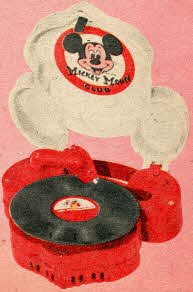 Mickey Mouse Phonograph
Price $9.95
Portable and battery operated. Safe for children. No wires, no plugs. Automatically starts and stops. Has Vani-tone Volume Control. Comes in official Mickey Mouse Club carrying case including batteries.
Iran --- Nationalization in Iran
Shah of Iran restored to power
More Information and Timeline For Nationalization in Iran
1. 1950 - General Haj-ALi Razmara becomes the Prime Minister of Iran
2. March 1951 - Prime Minister Razmara is assassinated
3. March 1951 - Mohammed Mossadegh presents the idea of nationalization of the Anglo-Iranian Oil Company to the Iranian Parliament and it is eventually approved by the Iranian Parliament
4. April 1951 - Mossadegh is elected as Iran's new Prime Minister
5. May 1951 - Britain imposes an embargo on Iranian oil and bans the exportation of goods to Iran in retaliation. Britain also mobilizes its navy as a show of force
6. June 1951 - The United States, under President Truman, tries to mediate the situation between Iran and Britain diplomatically, while Britain decides to take legal action against Iran in the International Court of Justice
7. July 1951 - The International Court of Justice rules that the conflict could not be resolved by the ICJ because it was a problem between a private company and the Iranian government and not a matter of treaties
8. 1952 - Iran decides to sever diplomatic ties with Great Britain
9. 1953 - A failed coup against Mossadegh forces Shah Mohammed Reza Pahlavi to flee from Iran
10. 1953 - A second coup against Mossadegh is successful with the help of the CIA and the Shah returns to power in Iran
Shah Mohammed Reza Pahlavi ruled as an authoritarian leader until 1979 when he was overthrown during the Iranian Revolution
Korea --- The Korean War Ends
The Korean War ends after three years and one month
More Information and Timeline For The Korean War
1. 1945 - American & Soviet troops agree that the 38th parallel will be the military dividing line in Korea after WWII ends
2. 1948 - The Soviet Union aids in the creation of the People's Democratic Republic of North Korea
3. 1948 - The United States recognizes the Republic of South Korea
4. 1949 - US & Soviet troops withdraw from North and South Korea
5. June 1950 - North Korean troops invade South Korea
6. 1950 - US President Truman sends American troops under General MacArthur to the defense of South Korea, the United Nations approves and sends other troops
7. October 1950 - UN Forces recapture nearly all of South Korea below the 38th parallel and the UN authorizes troops to continue into the North
8. November 1950 - The Chinese Communist Army fights UN forces driving them back down the peninsula
9. 1951 - General MacArthur is dismissed from his command after months of insubordination
10. 1952 - Fighting continues amidst tense negotiations over whether or not there will be mandatory repatriation for Chinese and North Korean defectors
11. 1953 - US President Eisenhower informs the Chinese that he would not be afraid to use nuclear weapons or invade China in order to end this, North Korea decides to allow voluntary repatriation
12. July - An armistice is concluded at Panmunjom, it provided for a demilitarized zone and a conference to discuss the future of Korea, however, the conference never came to pass
During the Korean War 33,629 US troops, about 3,000 UN troops, about 50,000 South Koreans, and an estimated 1.5 million Communists from China and North Korea died.
Dwight D. Eisenhower is inaugurated as the President of the United States
Dwight D. Eisenhower is inaugurated as the President of the United States
More Information for Eisenhower Presidency
Dwight D. Eisenhower was inaugurated as the United States president during January . Republican Eisenhower and his running mate Richard Nixon defeated Democrat Adlai Stevenson with a total of 442 electoral votes to 89 and a popular vote of 55.2 percent to 44.3 percent. Eisenhower had previously been known for his service as a five-star general during World War II, eventually becoming the Supreme Allied Commander. He also acted as a Chief of Staff for the Army under President Truman, the governor of U.S. occupied Germany after WWII, the president of Columbia University and the Supreme Commander of NATO forces. During his two-term presidency he was credited with creating the U.S. highway system, strengthening Social Security, easing tensions with the U.S.S.R., creating NASA, helping to fully desegregate the Armed Forces, and signing some of the first modern civil rights laws.
U.S.S.R. - Hydrogen Bomb
The Soviet Union tests its version of the Hydrogen Bomb.
More Information for the Soviet Union's H-Bomb
The Soviet Union announces it has tested its own hydrogen bomb during August . The version that they tested was a "Layer Cake" bomb, a smaller and more portable version of the hydrogen bomb compared to what the US had tested in November of 1952. This announcement helped to increase the tension between the USSR and United States during the Cold War. It also greatly escalated the arms race between the two powers.
Popular Culture
Ian Fleming publishes his first James Bond novel, Casino Royale in the United Kingdom
Playboy Magazine's 1st issue features Marilyn Monroe as its first cover girl and nude centerfold.
New York Yankees win fifth world series in a row
Popular Films
Peter Pan premieres
The Robe
From Here to Eternity
Shane
How to Marry a Millionaire
The War of The Worlds
Gentlemen Prefer Blondes with Marilyn Monroe
Popular TV
Adventures of Ozzie & Harriet
I Love Lucy
The Lone Ranger
Popular Singers
Percy Faith
Perry Como
Frankie Laine
Patti Page
Tony Bennett
Nat King Cole
Part of our Collection of Home Appliances From the 50s
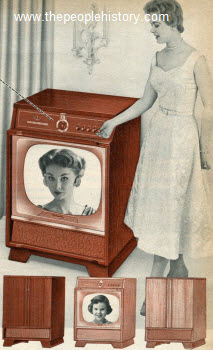 1955 24-inch Fringe TV Set
Price: $254.95
High definition picture. Twenty-five percent bigger than expanded twenty-one inch. Exceptional edge-to-edge focus means razor-sharp detail all over the screen. Aluminized screen with tinted safety glass provides a bright picture. The high-fidelity FM sound system has three speakers that distribute sound evenly around the room for amazing depth and liveness. Has plenty of reserve power for adverse fringe area conditions. Cascode tuner provides tremendous sensitivity with minimum noise and "snow". Deluxe "showpiece" cabinets. Choose from mahogany, blonde or limed oak veneer.
U.S. --- Polio Vaccine
First Polio Vaccine Developed
More Information and Timeline For Polio Vaccine Creation
1. 1908 - Karl Landsteiner & Erwin Popper first identify Polio as a virus
2. 1916 - A large Polio epidemic hits the United States, causing 27,000 cases and 6,000 deaths nationwide
3. 1929 - Philip Drinker & Louis Shaw develop the "Iron Lung" or tank respirator to help keep patients breathing in the early stages of Polio
4. 1938 - FDR founds the National Foundation for Infantile Paralysis, later known as the March of Dimes
5. 1948 - Hilary Koprowski tests his Type II Poliovirus vaccine on himself after testing it on chimpanzees and sees no harmful side effects
6. 1951 - Jonas Salk and a team at the University of Pittsburgh create a way to cultivate the poliovirus in monkey kidney tissue
7. 1952 - 57,628 Polio cases are reported in the United States, with over 21,000 of them being paralytic cases
8. 1952 - Salk and his associates begin testing their inactivated (or killed-virus) polio vaccine on humans
9. 1953 - Salk gives himself and his family the polio vaccine
10. 1954 - Field trials of Salk's vaccine begin with over 1.3 million children
11. 1955 - Trial results state that the vaccine is 80% - 90% effective and the US Government grants a license to Salk's vaccine
In 1955, distribution of the vaccine was suspended while more investigations were carried out after several reports that the virus did not work and paralyzed some children. Eleven people died from the vaccine while a few hundred were paralyzed from it, most likely as a result from certain manufacturers not using the proper production methods when creating the vaccination. The vaccination was allowed to continue after several changes were made to the production methods.
Soviet Union - Joseph Stalin Dies
1. Joseph Stalin, the leader of the Soviet Union, dies at the age of 74 on March 5th.
2. Stalin had been in power since 1924 after Vladimir Lenin’s death.
3. He was known for his totalitarian takeover of Soviet life and had reigned as a dictator in the Communist country.
4. He routinely purged his government and aggressively penalized opponents or perceived enemies through forced labor and executions.
5. While often praised for helping defeat the Nazis during World War II, he was also believed to be responsible for the deaths of between 5 to 25 million of his own people due to direct involvement or as a result of his political and economic policies.
6. After Stalin’s death, Nikita Khrushchev became the leader of the Soviet Union.
7. Khrushchev soon denounced Stalin and his policies and began an era of reform known as de-Stalinization.
United Kingdom -- Royal Yacht Britannia
1. The Royal Yacht Britannia was commissioned on February 4th, 1952.
2. The ship was ordered at the John Brown Shipyard in Clydebank, Scotland, the same place that built the Queen Elizabeth and Queen Mary ocean liners. It cost £2 million to build.
3. The HMY Britannia was launched on April 16, 1953.
4. Sea trials began on November 3, 1953.
5. It was commissioned into the Royal Navy on January 11, 1954.
6. Its maiden voyage took place between April 14 and April 22 in 1954 with Princess Anne and Prince Charles on board, traveling from Portsmouth, England to Grand Harbour, Malta.
7. Queen Elizabeth II and Prince Philip had their first trip on the yacht on May 1, 1954.
8. The ship was designed so that in times of war it could be converted into a hospital ship, but it was never needed for that purpose.
9. It made over 950 official voyages and traveled over 1 million nautical miles.
10. It’s final official voyage was carrying the Prince of Wales and Governor of Hong Kong away from Hong Kong in July of 1997 when the territory was handed over to Chinese control.
11. The Royal Yacht Britannia was decommissioned on December 11, 1997.
12. The HMY Britannia is now a museum, located in Edinburgh, Scotland.
Note - More official facts and figures can be found on the Royal Yacht Britannia website, including information on how to visit the museum and information on what daily life was like on board the ship.
Earl Warren is appointed to the U.S. Supreme Court.
More Information and Timeline for Earl Warren
Earl Warren is appointed as the Chief Justice of the United States Supreme Court by President Dwight D. Eisenhower on October 5th . Warren had previously been a three-term governor of the state of California and in 1948 he had been the republican candidate for vice president. Earl Warren was involved in several of the Supreme Court's most important decisions on subjects like civil rights, most notably the decision that made segregation in public schools unconstitutional. He was also the head of the committee that investigated the assassination of President Kennedy. Warren remained Chief Justice of the US Supreme Court until he retired in 1969.
Part of our Fashion Collection 1953
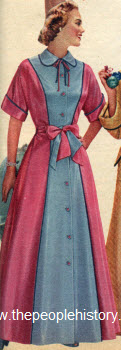 Two Tone Hostess Gown
Price: $8.75
Two-tone hostess gown in a fine acetate and rayon crepe that has a beautiful silk-like sheen. Navy piping, graceful six-gore skirt, fabric bow and buttons. Wonderfully flattering gift. Choose from melon rose with aqua blue or aqua blue with melon rose.
Part of our Fashion Accessories 1953
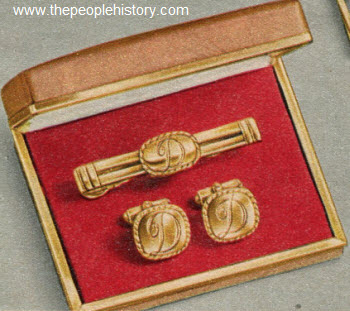 Men's Initial Cuff Links
Price: $3.95
Handsomely engraved tie clip and cuff link set with one initial. Highly polished. Choose from any letters except I, O, Q, U, V, X, Y, or Z.
Sir Edmund Hillary and Tenzing Norgay
On on May 29th Sir Edmund Hillary and Tenzing Norgay perform the first successful ascent to the summit of Mount Everest.
More Information for first Mount Everest ascent.
1. Sir Edmund Hillary, an explorer from New Zealand and Tenzing Norgay, a Nepalese Sherpa, become the first people to successfully climb to the summit of Mount Everest in May .
2. The pair stayed at the summit for about fifteen minutes before they had to begin their descent due to low oxygen.
3. Before Hillary and Norgay accomplished the feat several other mountaineers had attempted to reach the summit of the highest mountain but had never been successful and many had even perished in the attempt.
Cambodia becomes independent from France.
More Information for Cambodia's Independence.
Cambodia declares its independence from France during November . King Sihanouk, having previously pushed for independence, took over as the country's leader. Starting in 1946, Cambodian resistance fighters had launched armed attacks against French occupation in a push for independence. Cambodia had been under French-colonial rule for ninety years prior to its independence. After achieving independence the country remained the Kingdom of Cambodia until 1970 when Norodom Sihanouk was overthrown in a United States backed military coup.
Born This Year in 1953
Tim Allen
Born: June 13th Denver, CO
Pierce Brosnan
Born: May 16th, Drogheda, Ireland
John Edwards
Born: June 10th Seneca, SC
Hulk Hogan
Born: August August 11a, GA
Cyndi Lauper
Born: June 22nd Brooklyn, New York, NY
Michael Bolton
Born: February 26th New Haven, CT
Kim Basinger
Born: December 8th, Athens, GA
Tony Blair
Born: May 6th Edinburgh, United Kingdom
Meredith Vieira
Born: December 30th Providence, RI
Queen Elizabeth II crowned queen of England on June 2nd in UK.
Queen Elizabeth II crowned queen of England on June 2nd in UK.
More Information for Queen Elizabeth II's Coronation
Queen Elizabeth II's coronation took place June 2nd in the United Kingdom. The coronation was held at Westminster Abbey where thousands of guests gathered to witness the historical event. Elizabeth's father King George VI had passed away during February of the previous year, and not long after his death Elizabeth began her duties as a monarch. She was not formally crowned until the coronation as it was tradition to allow several months to pass for mourning of the previous monarch. It was the first coronation service to be broadcast on television.
double-helix discovery
James D. Watson and Francis H.C. Crick announce discovery of the double-helix structure of DNA.
More Information for the discovery of the Double Helix.
British physicist Francis Crick and American biologist James Watson discover the double-helix structure of human DNA in February . DNA had been studied since the mid-1800s, but they were the first to figure out that DNA was formed as a double helix, a ladder-like shape, that split up to replicate, unlocking how the passing on of genes worked. At about the same time scientists Rosalind Franklin and Maurice Wilkins were using x-rays to study DNA and were able to provided proof of the double helix structure in one of their images. Watson and Crick published their finding in April of that year. In 1962 Crick, Watson and Wilkins were awarded the Nobel Prize in Medicine or Physiology (Franklin had died several years earlier of cancer).
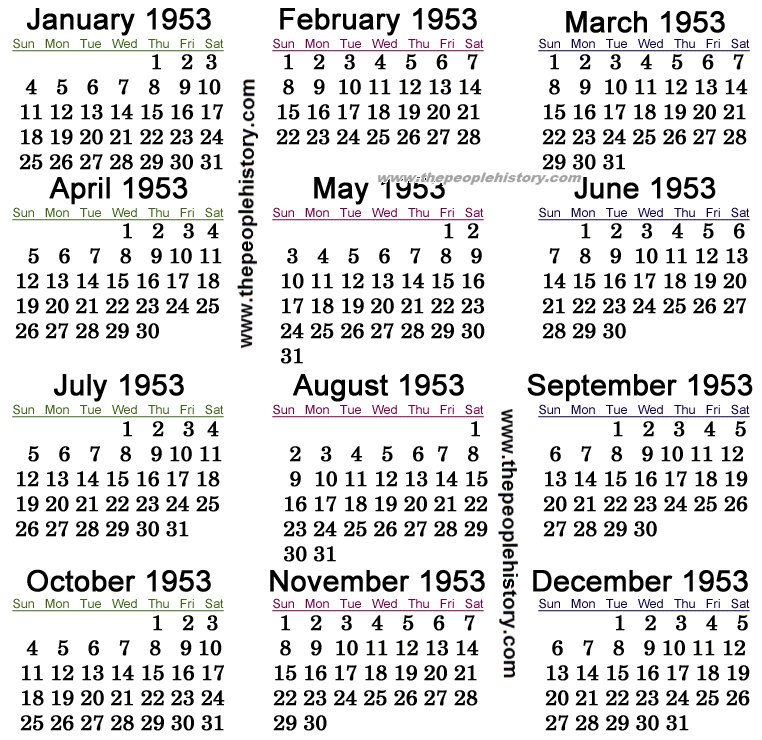
Calendar For The Year 1953
Part of our 1950s Furniture
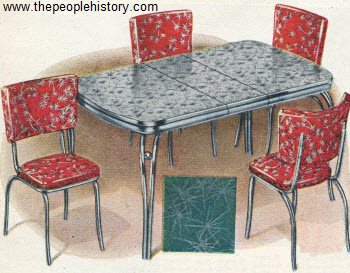 1952 Starburst Plastic Table Set
 Price: $110.00
New unusual "starburst" design on a chrome-plated dinette set. Like sparkling stars against brilliantly colored backgrounds. Table comes in dark mint green, sunshine yellow, cherry red, or dawn gray. Three inch rounded stainless steel apron on table and matching twelve inch center leaf. Chairs have extra-large backs with extra-deep curve for comfort.
U.S. Executive Order 10450
President Dwight D. Eisenhower signed Executive Order 10450 on April 27th which defined controversial hiring and firing rules for Government Employment
U.S. FBI rounds up communist leaders
The FBI rounds up communist leaders who were advocating overthrow of the Government
U.S. right-to-work laws
The U.S. Supreme Court gave power to enforce right-to-work laws
U.S. Tornado Waco
F5 Tornado strikes Waco in Texas on May 11th leaving 114 dead and 597 injured, The Tornado was one of the many storm disasters for the development of a nationwide severe weather warning system.
UK storms
The strongest storms ever recorded break through flood defenses across the UK leaving 150 dead
Russia Stalin
Death of Soviet Premier Stalin
France massive strike
Four million workers go on a massive strike in France
Russia crushes protests
The Soviet Union crushes protests against the communist government of East Germany
Netherlands North Sea flood
North Sea flood of 1953 kills 1,835 people in the southwestern Netherlands
Turkey earthquake
An earthquake hits western Turkey killing 250
Kenya Jomo Kenyatta
Jomo Kenyatta the future leader of Kenya is sentenced to seven years hard labour
South East Asia Hurricane
Hurricane in South-East Asia - over 1000 dead
UK Sugar Rationing
Rationing of sugar ends in the United Kingdom
Technology
Albert Schweitzer was given the Nobel Peace Prize.
The first color television sets go on sale for about $1,175 in the US
New York adopts three color traffic lights
The Corvette the all American sports car goes on sale
Cigarette Smoking is reported as causing Lung Cancer
British Physicist Francis Crick and US Biologist James Watson unveil their famous Double Helix Model of DNA the materials in Chromosomes that control heredity
Inventions Invented by Inventors and Country ( or attributed to First Use )
Transistor Radio USA from Texas Instruments
Major World Political Leaders
Australia -- Prime Minister -- Sir Robert Menzies --
Brazil -- President -- Getúlio Vargas --
Canada -- Prime Minister -- Louis St. Laurent --
China -- Chairman of the People's Republic of China -- Mao Zedong --
France -- President -- Vincent Auriol --
Germany -- Chancellor -- Konrad Adenauer --
India -- Prime Minister -- Jawahar Lal Nehru --
Italy -- Prime Minister -- Alcide De Gasperi -- Till 2 August
Italy -- Prime Minister -- Giuseppe Pella -- From 17 August
Japan -- Prime Minister -- Shigeru Yoshida --
Mexico -- President -- Adolfo Ruiz Cortines --
Russia / Soviet Union -- First Secretary of the Central Committee of the Communist Party of the Soviet Union -- Nikita Khrushchev --
South Africa -- Prime Minister -- Daniel François Malan --
United States -- President -- Harry S. Truman -- Till January 20,
United States -- President -- Dwight D. Eisenhower -- From January 20,
United Kingdom -- Prime Minister -- Sir Winston Churchill --